34 seconds
How a single image erased three decades of trust

It started while I was researching 1930s Europe for a novel I’m working on. Writing historical fiction has a way of sending you down unexpected paths as you try to make every piece fit together.
For me, that path led to zeppelins.
Those early decades of the twentieth century were full of remarkable technological breakthroughs alongside decisions that are difficult to understand today. Among them was transatlantic travel by airship: slow, certainly, but also astonishingly sophisticated.
What I didn’t know—and what completely changes the story—is that, for years, it was actually the safest form of long-distance transportation of its era.
Thirty years of statistical silence
For more than thirty years, commercial airships carried tens of thousands of passengers across more than two thousand flights, covering over one million miles.
The Graf Zeppelin, the most famous of them all, completed 590 flights, carried 13,110 passengers, and logged more than a million miles.
Not a single passenger died.
Not one.
Over three decades of commercial passenger service by airship, passenger fatalities were essentially zero.
Meanwhile, conventional aviation was producing a safety record that insurance companies translated into very concrete numbers.
In 1932, insuring a $5,000 airplane journey cost two dollars. The same insurance for a train trip cost twenty-five cents.
Flying cost eight times more to insure than traveling by rail, and that gap wasn’t the product of cautious underwriters—it reflected mathematics based on actual accidents.
That same year, the president of American Airlines felt compelled to publish an advertisement titled,“Why Avoid This Question: Are You Afraid to Fly?”
Because that was exactly how the public felt.
And the facts justified it.
The year everything was caught on camera
In 1937 alone, conventional commercial aviation suffered multiple fatal accidents that have largely disappeared from collective memory.
Dozens of people died in commercial airplane crashes that year.
There were no cameras.
The zeppelins had gone thirty years without losing a single passenger.
And yet.
7:25 p.m., Lakehurst, New Jersey
On May 6, 1937, the Hindenburg attempted to land at Lakehurst, New Jersey, at the end of its first transatlantic crossing of the season.
There were 97 people on board, passengers and crew combined.
Newsreel cameras were waiting.
Photographers were waiting.
Even a radio reporter, Herbert Morrison, was there, experimenting with delayed audio recording for his Chicago station—something entirely new at the time.
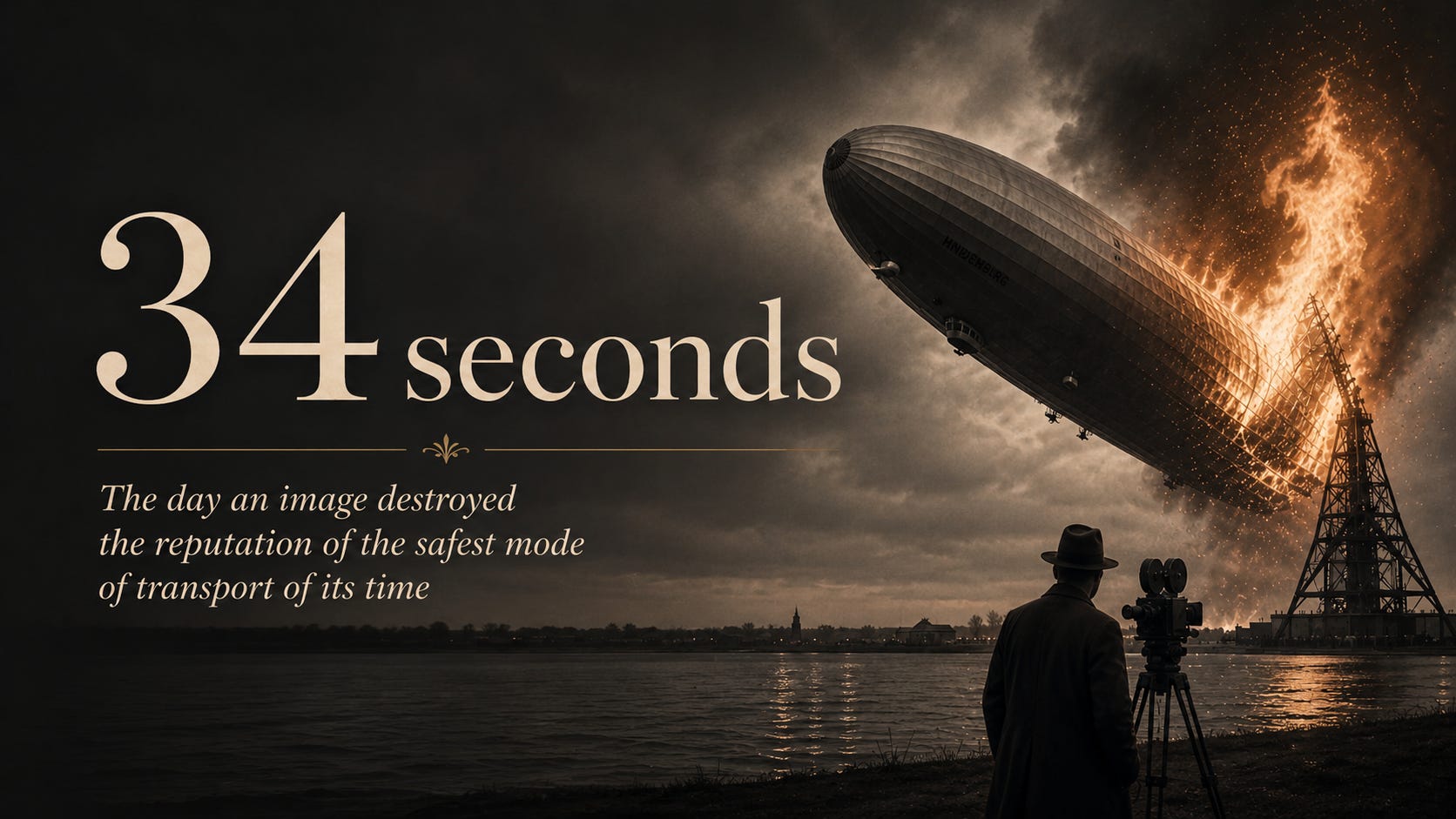
At 7:25 p.m., something ignited the hydrogen.
Thirty-four seconds later, the largest airship ever built was nothing more than an aluminum skeleton lying on the ground.
Thirty-six people died.
Sixty-two survived—more than sixty percent of those aboard—partly because hydrogen burns upward rather than spreading like gasoline, and partly because many passengers were able to jump as the tail touched the ground.
It was a genuine tragedy.
Real people died.
Nothing about this diminishes that.
The first filmed catastrophe
Footage of the burning Hindenburg was shown in movie theaters around the world as part of the newsreels.
Morrison’s voice breaking as he cried, “Oh, the humanity!”, became one of the defining broadcasts in media history.
For the first time, millions of people witnessed the same disaster, accompanied by the same emotional soundtrack.
Nothing like it had ever happened before.
Then I came across the detail that disturbed me most.
The Hindenburg had been designed to fly with helium—a nonflammable gas.
Had it been filled with helium that day, the disaster almost certainly would not have occurred.
But the United States controlled virtually the world’s entire helium supply, and American law prohibited its export to foreign nations.
German engineers had little choice but to use hydrogen.
What historians point out is even more unsettling.
Germany never formally requested helium from the United States.
By 1936, American helium production had expanded so dramatically that the request might well have been approved.
The Hindenburg could have flown with helium.
It would not have burned.
And everything that followed might have looked very different.
What might have happened?
Engineers were already designing the next generation of airships—larger, faster, and more efficient.
Regular passenger routes between Europe and America, and between Europe and Asia, were already being planned.
Zeppelins were never going to compete with airplanes on speed.
They competed on something else.
Crossing the Atlantic in three days while enjoying a level of comfort closer to an ocean liner than to early commercial aviation.
Today, airships are quietly making a comeback, particularly for cargo transportation, where they promise greater efficiency and lower emissions than many existing alternatives.
The technology that disappeared in thirty-four seconds in 1937 may have had a much longer future.
When an image defeats reality
Reputation is built not only on what you do, but on what people remember you doing.
Collective memory does not operate on statistics alone.
It responds far more readily to images.
To a breaking voice.
To thirty-four seconds of film captured at the precise moment nobody expected to witness catastrophe.
The zeppelins had thirty years of flawless data on their side.
They had engineering.
They had experience.
What they didn’t have was any way to manage what happens when your worst moment is captured on camera, amplified, and shown simultaneously to millions of people who lack the context to interpret it.
A political decision in Washington.
A stormy evening in New Jersey.
Cameras positioned in exactly the right place at exactly the right moment.
And suddenly, thirty years of impeccable data no longer mattered.
Because it isn’t simply that perception matters.
It’s that a single image can erase decades of earned reputation in a matter of seconds.
This essay is not an attempt to explain the history of aviation, nor to prescribe how reputational crises should be managed.
It’s simply one way of looking at a case that, with the benefit of hindsight, is more unsettling than it ought to be.
Any overinterpretation is mine.
The feeling that we still respond the same way may be yours.